What Comes After Knowledge Is Solved?
December 19, 2025
This is very similar in topic to my AI is the Pulley essay. Whereas that one is a bit more contemplative, this one is a bit more sociological (and cynical).
For basically all of human history, human survival depended on physical labor. Then, over about 150 years, we solved it. Machines could do the work of hundreds of humans.
You'd think this would have been celebrated as humanity's greatest triumph. Freedom from backbreaking toil, which should have freed up time for leisure and intellectual pursuits.
That's not what happened.
When Labor Was "Solved"
The Industrial Revolution didn't free workers—it displaced them into new forms of work. Most would consider this a positive outcome, considering the fears at the time were massive displacement, unemployment, and the loss of traditional skills. (That's not to say we didn't encounter those problems, but after a very rough transition period, the chief result was a transfer of work to new domains, rather than the wholesale destruction of livelihoods.)
But in the aftermath of the Industrial Revolution, we also lost a few things. We lost the tangible connection between effort and outcome, autonomy over pace and process, and mastery of complete skills (replaced by assembly line fragmentation). We gained factory jobs monitoring machines, office jobs pushing paper, and service jobs performed with mandatory enthusiasm. The result was a proliferation of (pardon the language, it's a term) bullshit jobs that exist only to justify other bullshit jobs. We have experienced the great detachment.
If you want a survey of the current state of work, consider the three charts below (all from Gallup):
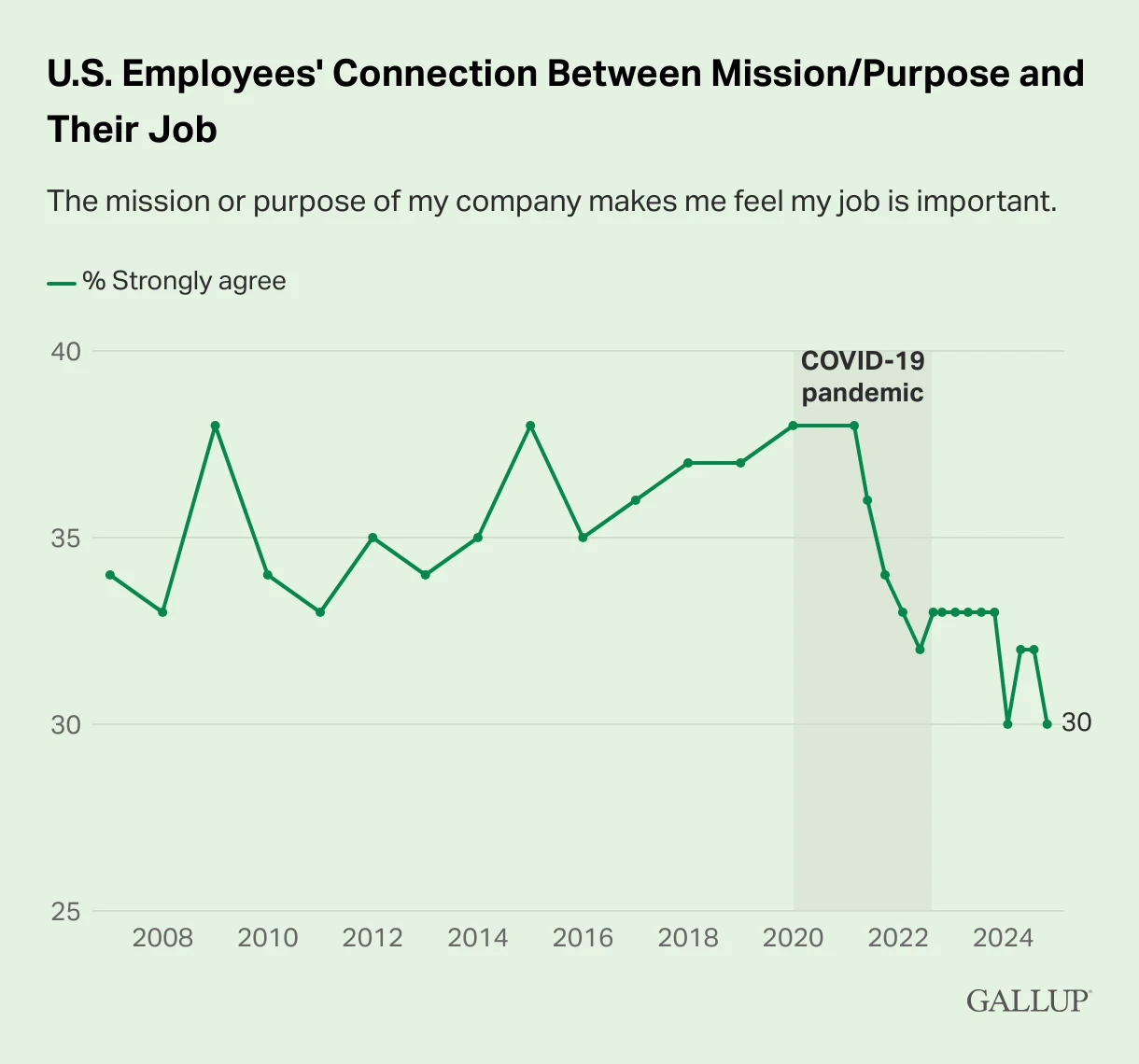
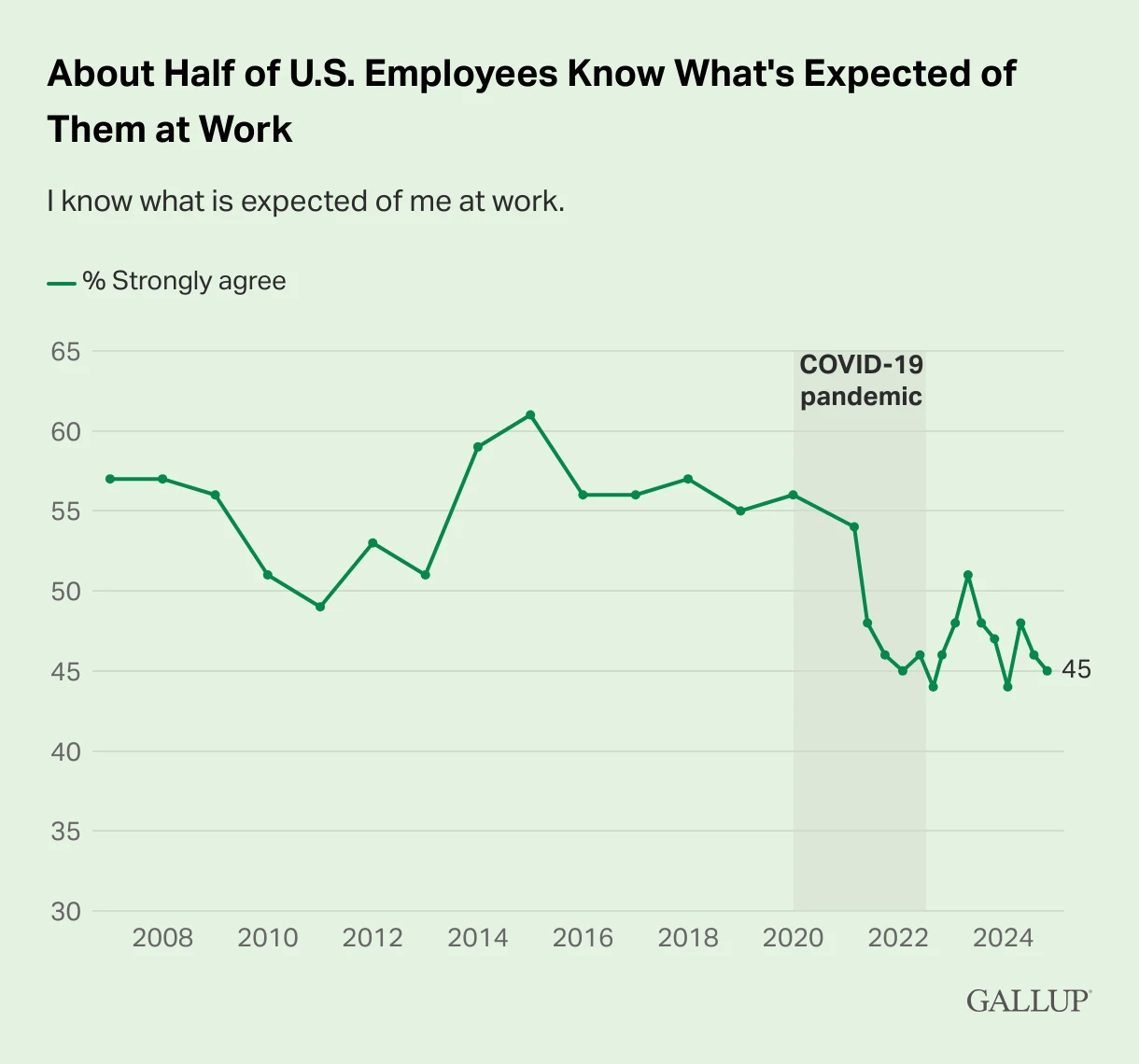
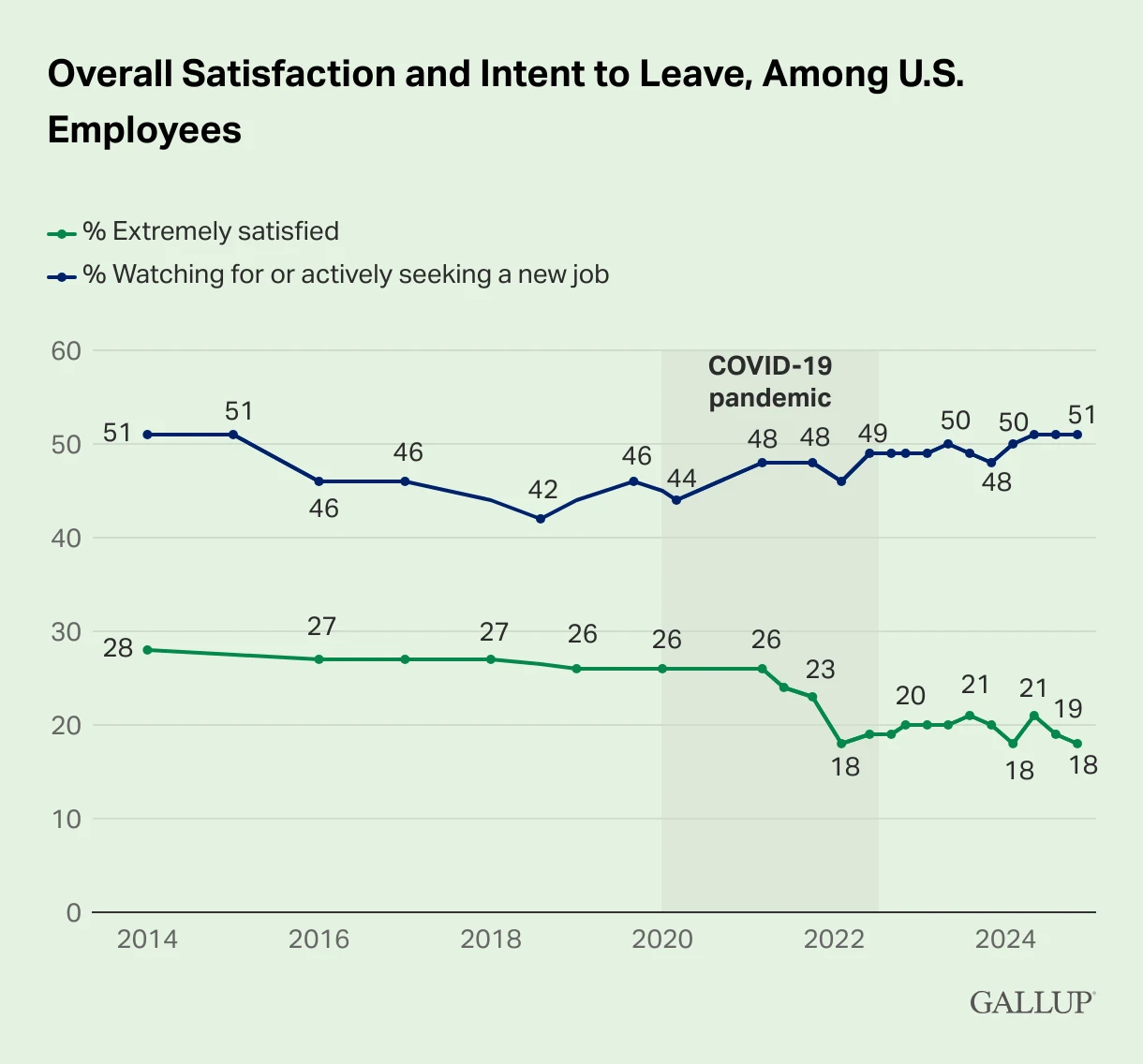
These charts only show data from 2014-2025, but the starting points from 2014 are still bleak and prove the point just as well.
And so automation didn't eliminate work, it eliminated the meaningful part and left the residue. The stuff too annoying, too political, or too weird to automate became the job.
The lesson from "solving" labor was that solving a problem does not eliminate scarcity, it just changes what's scarce. When we solved physical production, food became abundant. Now, positional goods (luxury items, experiences, education, real estate) are scarce. Status has become scarce (who manages whom), and meaning has become scarce (what work feels worthwhile). By reducing the need for abundant physical labor, we entered an age of new, weirder competitions for new, weirder resources.
Now We're Doing It Again
We're in the early stages of "solving" knowledge work the same way we solved physical labor. When I say "knowledge", I'm referencing procedural knowledge: knowing how to do things. How to write code, design interfaces, analyze data, draft contracts.
LLMs can write, analyze, code, research. They're not perfect, but neither was early machinery.
And just like last time, we're being told this will free us. We'll be "augmented." We'll focus on "higher-level thinking." If history is any guide, that's not what's going to happen.
Instead, lets consider what gets automated: the parts that are skilled, difficult, and satisfying—complex analysis, creative problem-solving, deep research, technical expertise. What remains for humans: the parts that are annoying, political, or liability-laden. Reconciling conflicting AI outputs, explaining decisions to skeptical stakeholders, being the scapegoat when something goes wrong, adding a "human touch" to prove you're not redundant.
This is the same pattern as physical automation. We didn't keep humans in manufacturing because they're better at the satisfying parts. We kept them for quality control, maintenance, dealing with exceptions, and being legally responsible.
Willem Van Lancker writes about this as the loss of "productive friction"—the struggle that builds expertise. Any designer or craftsman knows of the importance of hard work and practice. The friction that, in the moment, feels frustrating, but over time, develops taste and judgment. Now AI can generate polished designs instantly, but it skips the part where you build the internal compass that tells you what's actually good.
AI Middle Management: Your Consolation Prize
We solved physical labor and gave everyone office jobs. Now we're solving knowledge work and the consolation prize is: you get to manage the AIs.
Your day as an AI Manager (congrats on the promotion!):
- Prompt six different AI agents to research competitive landscape
- Spend an hour reconciling their conflicting outputs
- Attend meeting to explain what the AIs concluded to stakeholders who don't trust them
- Be the legally responsible human when the AI hallucinates a fake regulation
- Justify your salary by finding the 3% of edge cases the AI missed
You're not doing knowledge work anymore. You're managing knowledge workers that happen to be software. And the worst part? You know the AI is better at the actual thinking. Every "improvement" you make is performance—proving you're slightly better than nothing so they don't eliminate your role entirely.
Consider your work in 2020 to your work in 2026:
- 2020: You're a financial analyst. You build models, find insights, make recommendations. The thinking is yours.
- 2026: You're a "Financial Intelligence Manager." You assign research to AI agents, validate their models, and present their insights. You're the translator and liability shield.
One of these feels like a career. The other feels like glorified quality control.
This will likely be sold as human-AI collaboration. Keeping humans "in the loop." Augmentation, not replacement. Sure—but the problem is that we are continuing the same pattern of removing the meaningful parts of work and leaving the rest to humans.
My theory is that the more you disconnect a man from his craft, the more miserable he becomes. Many think that the axis that matters is "ease" of work, but really I think it's connectedness to one's work. This becomes clearer as you get older; ask a 18 year old what they want in work, and they'll say "less of it"—ask a 28 year old what they want in work, and they'll say "more of the parts that matter." (This is not true for everyone, and many people are happy with their tedious and abstract work because it is a means to an end. But they also tend to be more miserable in my opinion...)
After Knowledge Comes...
Maybe subjective wellbeing requires struggling against genuine constraints. Exercising real capability and seeing actual results. If that's true, then "solving" new categories of work doesn't liberate us—it removes domains where we can experience agency and mastery.
We took away the satisfaction of building physical things with our hands. Now we're taking away the satisfaction of figuring things out with our minds. What's left? Being the human in the loop. The liability sponge. The explainer of AI outputs to other humans who are also just explainers of AI outputs.
So what actually comes after knowledge is solved? Not wisdom. Not better judgment. Not meaningful work. Based on what happened when we solved physical labor: more abstract forms of BS. Work that's even harder to explain at dinner parties. Jobs that exist primarily to justify other jobs. Performance of value in increasingly indirect ways.
The same 40-hour weeks, but now you're managing bots instead of thinking. The same status hierarchies, but now they're based on who manages the most expensive AI subscriptions. The same existential emptiness, but now you can't even pretend your work requires a human mind.
We solved physical labor and got office parks. We're solving knowledge work and we'll get... whatever comes after office parks. Probably something even more abstract and depressing.
Welcome to the future of work, and congratulations on the promotion.